Latest luxury goods market report reveals two trends: one is from the physical environment to digital experience; the second is the luxury consumer demand for individuality growing.
- Two Major Trends
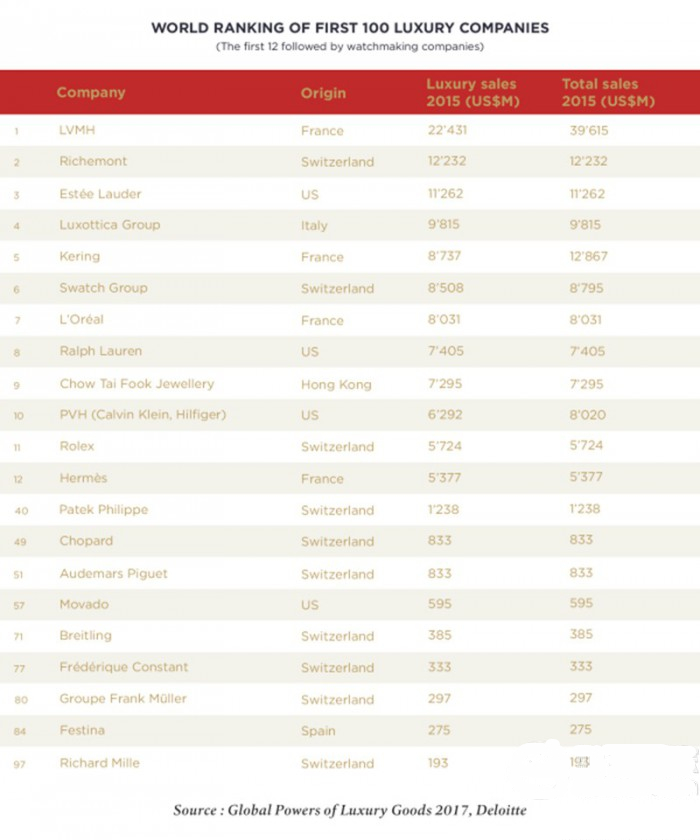
According to Deloitte Touche Tohmatsu in 2017 the world's top luxury goods list (the report lists the world's top 100 largest luxury goods company), Italy has the largest luxury goods company (a total of 26), while France is the highest share of sales. Of the 100 companies, 10 are Swiss watchmakers. As of June 30, 2016, the cumulative net sales of these 100 companies reached US $ 202 billion, up 6.8% year on year, consolidated net profit rate of 9.7% and consolidated assets of 7.9%. In other words, taking into account the global economic environment, the performance of the luxury market is not bad, which in February 2017 in 11 countries, more than 1,300 luxury consumers in the survey report has been confirmed. "Our analysis found that consumer spending on luxury goods remained relatively strong over the past five years, with only a small percentage (4%) indicating a decrease in spending, and consumers in emerging markets continued to drive growth."
More interestingly, the report reveals two major trends in shaping the luxury market. While quality is still a key driver of luxury consumption - 93% of Chinese consumers buy luxury for quality - luxury is the same important factor in bringing consumers to subjective feelings. "This involves the intangible quality of luxury goods," Deloitte said. "In our survey, more than half of the respondents admitted that their conspicuous consumption, the purchase of luxury products is purely in order to have some of the goods brought the status of the 'status' is no longer 'I have what' But more about 'who I am.' Consumers are also very clear that they will digital as the future of luxury goods. "Deloitte said that this will become a major challenge for luxury goods, which must try to incorporate digital technology Its products, while continuing inheritance heritage, focus on traditional skills. The report cites de Grisogono and Samsung as well as Hermes and Apple's recent collaboration as an example.
-
New Expectation
Distribution network in the forefront of change, the whole channel distribution as the leading model of luxury goods industry (mainstream retail industry is already the case). Although e-commerce continues to rise, but the report shows that there are still 63% of luxury consumption in the store. As expected, the millennials were most affected by digitization, and 42 percent of their consumer transactions were made through computers or mobile devices. Report another survey results show that multi-brand stores accounted for 78% of online luxury consumption, while the single-brand stores are online retail dominated. This reflects the popularity of online sites such as Yoox Net-A-Porter, as well as the lack of major luxury brands to invest in online channels, which are more likely to extend their physical networks to new markets.
The result of this expansion is that luxury brands tend to provide a consistent standardized experience, while consumers (for example, from New York to Kuala Lumpur) seek multiple experiences. According to the Deloitte survey, today's luxury consumers want to have more channel options (39% need to be delivered home), more loyalty awards (44% think there should be a gift return), and more attention (45% Expect personalized goods and services). Digital channels are creating personalized and premium content requirements, but how can brands be offered on a large scale? Some luxury goods companies choose to talk to customers and incorporate them into the marketing process. Now, the customer is king; soon after, they will become emperors.